Pie Chart of Employers Reviews of Employees Performance
Page Content
Most workers value candid discussions on workplace operation. They want regular and more-transparent functioning feedback. Simply employees don't believe that direction has a good grasp of performance assessments and related guidance.
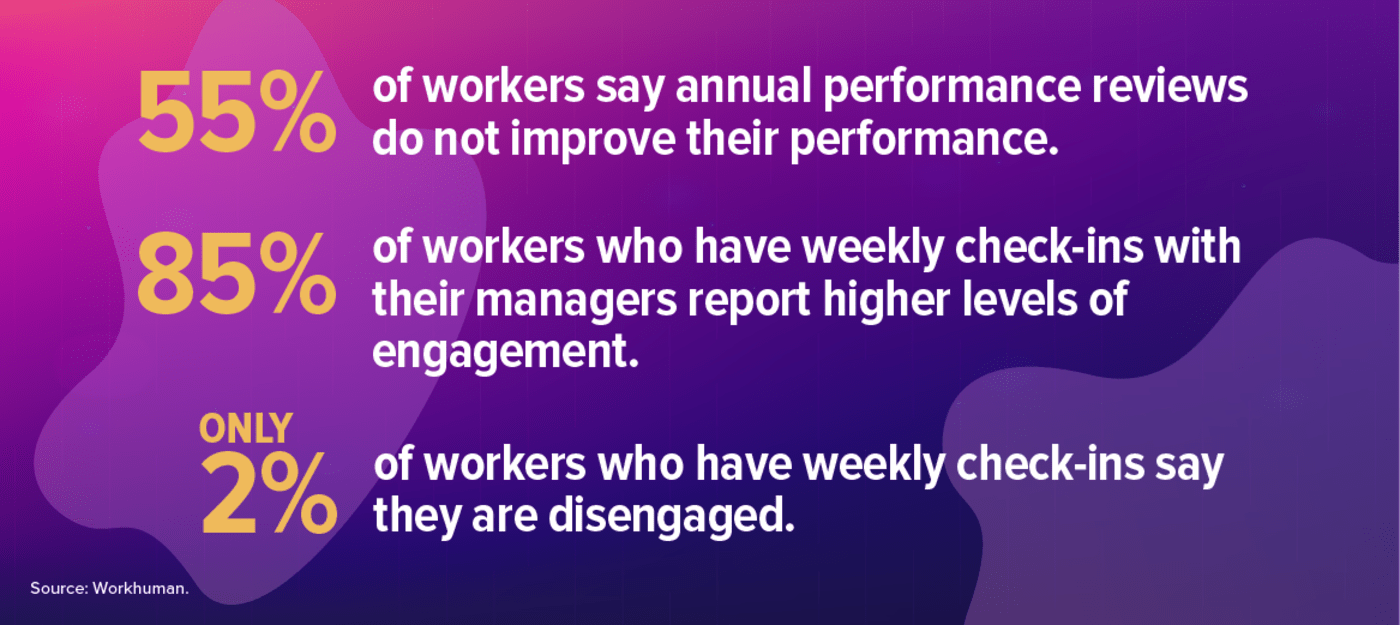
Sometimes the review procedure does more than harm than good. According to a 2019 study from Gallup, merely nigh 10 percent of U.S. workers felt engaged subsequently receiving negative feedback on the chore. And well-nigh 30 per centum were so put off by a negative review that they began actively looking for a new chore. Moreover, 55 per centum of workers believe annual reviews don't improve their performance, according to a 2019 Workhuman Analytics & Research report.
So, it'southward not surprising that the number of companies conducting annual or semiannual reviews has fallen in contempo years. "The traditional operation-management arroyo has become outdated," says Rosette Cataldo, vice president of performance and talent strategy at Workhuman, a human capital management software company.
Some companies have begun moving toward providing continuous, real-time feedback throughout the year. "This new-and-improved model is reflective of how piece of work actually gets washed and leads to increased appointment," Cataldo says.
Then Many Problems
If you enquire a workplace expert—or an employee, for that matter—what'south wrong with the functioning-review processes, the answer might exist, "Where do I start?"
"The challenge with annual reviews is that they're a collection of indirect, out-of-context feedback that a supervisor or dominate is supposed to evangelize long after a project has ended, and so the feedback is no longer educational or useful," says Susan Clarke, co-founder of Thrive, a coaching and consulting business firm in Whitefish, Mont.
"Feedback is scary to many," says CrisMarie Campbell, Thrive'southward other co-founder. "People often think it means that they did something wrong or that the other person is mad at them." And that may be why we avoid giving that feedback in real time, she says.
Feedback is more effective when check-ins are frequent. "That way, you lot're able to clarify expectations earlier a team member or colleague gets too far alee in a task or a projection," Campbell says. And workers who bank check in with their manager at least weekly are five times less likely to be disengaged than those who never check in, Workhuman found.
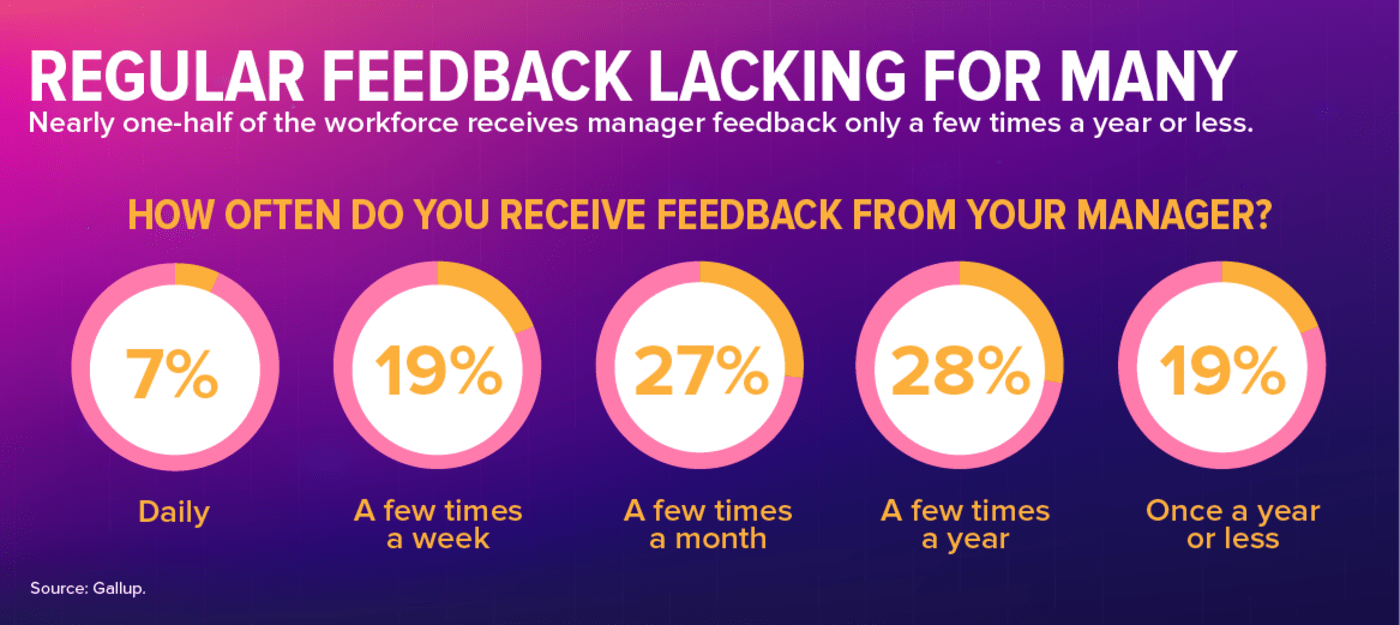
Evidence is growing that organizations are getting meliorate at recognizing and valuing staff members, with the approach shifting in ii significant ways, according to Kyle Brost, chief executive officer at Spark Policy Constitute, a Denver-based business concern consultancy that specializes in corporate employee engagement tools and strategies.
"First, leaders are looking for more than ways to utilize data," Brost says. "Feedback can be very subjective and lack context. For this reason, leaders are turning to more data sources to inform feedback."
That approach offers several advantages. "Data emphasizes both individual contributions and organizational processes that are working, along with any misalignments betwixt the two," Brost says. "Additionally, the sources and means for collecting this data are becoming increasingly accessible, man-centered and convenient." For instance, information software packages such every bit 7Geese, Bamboo HR, CRG emPerform, Officevibe and Saba Cloud all have tools to aid managers provide feedback on a regular, yr-round footing.
'For companies to be agile, feedback must go
closer to existent-time.'
Karen Crone
Second, the onetime approach to feedback equally a one-way street, where the system's leaders are all-knowing and the employees simply demand to become up to speed, is quickly dissolving.
"Private perspective, expertise and value are being recognized at a greater level than ever before," Brost says. "This ways that feedback is no longer about the organization simply talking at the employee. It'southward becoming a 2-way street where individuals are able to bring feedback to the organization."
Only nosotros're not there, yet. he says, "The structure, intent and outcomes of feedback notwithstanding need to shift to align with this more accurate and valuable arroyo."
Tighter Review Cycles
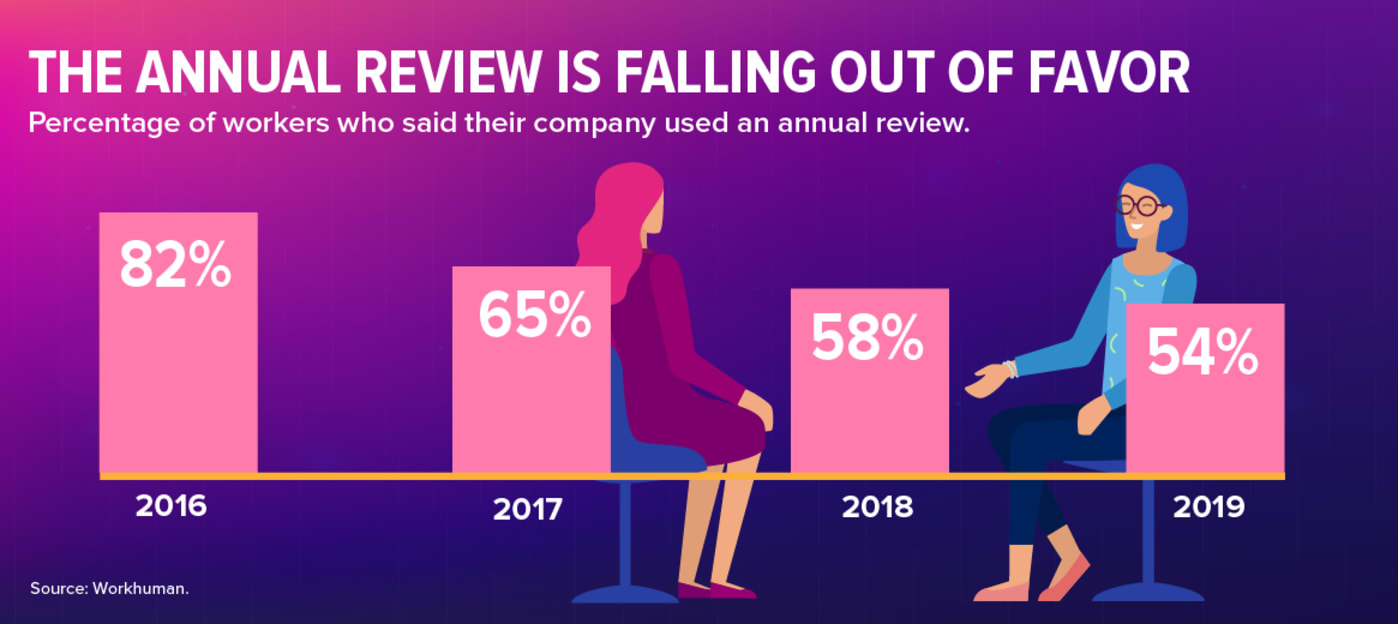
One trend companies are turning to is a tighter feedback calendar bicycle. Consequently, the in one case-yearly employee review is falling out of favor.
In 2016, 82 pct of workers surveyed said their visitor used an annual review. That number dropped to 65 percent in 2017, 58 percent in 2018 and 54 percent in 2019, according to the Workhuman report.
"Feedback will become more informal, more iterative and more frequent," says Karen Crone, chief human resource manager at Paycor, a human capital management company.
Paycor has 12-week operation discussion cycles chosen "CONNECT sessions," according to Crone, which better mirror the company'south business model and include employee reviews.
"Think virtually it as a 12-week year," she says. "In that regard, our employee discussions don't crave a laborious form, but rather a quick-striking review of what's been accomplished, what'due south next and how the person is developing. That way, the employee and the manager have an equivalent vocalisation in preparing for the chat."
Paycor wants its employee feedback sessions to exist "breezy, iterative, frequent and counterbalanced," Crone says, with managers and employees sharing responsibility for the reviews. "For companies to be agile, feedback must go closer to existent-time."
Employees are encouraged to take an active function in the process. "As more than work is completed in cocky-guided teams, team members have more responsibility for feedback," she says. "The managing director continues to be the focal point for career conversations, with performance assessment coming from the team, and team members holding ane another accountable, supporting one another when in that location are obstacles and pointing out missed expectations."
Internal Feedback Tools
Southwardome companies are post-obit suit and developing their ain employee-axial evaluation models that don't look like the "1-and-done" evaluation model that old-line companies were doing decades ago.
"At PwC, we believe in the power of frequent, informal feedback," says Rod Adams, U.S. and Mexico talent acquisition leader at the consultancy. "Allowing for regular feedback conversations, versus the traditional annual review, helps individuals to maximize their strengths, apace close gaps, and bulldoze learning and development in real-time throughout the year."
PwC has accelerated that process with its own real-time feedback tools.
"We have developed what we telephone call the PwC Professional for real-fourth dimension feedback," Adams says. "All our staff are recruited, developed and managed against the PwC Professional's five attributes for leadership, which are whole leadership, concern acumen, technical capabilities, global acumen and relationships."
The PwC feedback model allows managers to leverage a 360-caste feedback program with performance management and career development tools that assemble insights from anybody in the workplace—managers, peers and subordinates. Information is collected through a combination of surveys, reports, and coaching and collaboration tools. PwC also tracks feedback over time and charts progress beyond the v areas of leadership, he says.
The company conducts regular staff engagement surveys, Adams says, and the employee response to the real-time feedback culture is overwhelmingly positive. "It's a win-win for anybody, allowing for real opportunities to acquire on the job while also encouraging leadership at all levels."
Communication in a Crisis
When the threat of the coronavirus became apparent earlier this year, feedback became much more difficult at companies across the country.
"Working apart from your team is very challenging as y'all're not certain of their progress and how things are going," says Michael Lowe, CEO at CarPassionate.com, an motorcar parts web platform based in Phoenix. "It's easier at the workplace, where you can become visit an employee on the job or they tin come to y'all and discuss productivity or chat about plans." When working remotely, Lowe stressed the demand for the right tech tools and software to better connect with employees.
"Providing employees with skilful feedback shouldn't be a challenge if you're using the right cess tools [such every bit employee evaluation platforms] and communication tools [similar videoconferencing]," says Pete Sosnowski, co-founder at Zety, a job search platform based in Warsaw, Poland.
"Remote piece of work requires an increased focus and motivation to maintain productivity," Sosnowski says. "There are many factors that can disrupt standard work activities, from the unsuitable work environment, the presence of family members and distractions, to lack of work peers and managers."
To overcome those disruptions, he recommends that companies provide frequent feedback. For case, instead of quarterly reviews, he suggests aiming for monthly or biweekly feedback.
Managers can besides solicit feedback from workers. "As a manager, you're put in a completely new situation, every bit well, in managing a remote squad," Sosnowski says. "You should use feedback from your team members to come across how you're treatment this new state of affairs."
When providing feedback and direction remotely, clarity must exist a priority, says Jake Penney, head of human resources at English language Blinds, an online blinds and home decor company based in Solihull, England. "During the COVID-19 crisis, providing feedback remotely and ensuring that the right message gets across can be challenging," he says, "because there'south so fiddling context and tone for such remote interactions." He recommends speaking by phone or video conferencing to personalize feedback and reduce the chances of misunderstandings.
Existent-Fourth dimension Feedback
What will reviews wait like in the hereafter? Certainly, fourth dimension-honored traditions such as meaningful face-to-face interactions (even if it's via Skype) will prevail—with a heavy dose of 21st century technology added into the mix.
"The almanac performance review is a retrospective, and looking backward over a full year can exist useful," says Michael L. Zirulnik, executive director of The Varsity Project, a advice consultancy in Phoenix, Ariz. "But without context, it's often too distant for u.s.a. to exercise much of annihilation with, and employees may walk away unhappy."
That's why more companies are leveraging increased technological feedback in chore-oriented environments.
"For instance, on the flying deck of an aircraft, there are dozens of tech tools offering pilots feedback they can use immediately to meliorate the performance of the aircraft and how they fly," Zirulnik says. "If you're a pilot or a surgeon getting real-time feedback from technological tools that enables prophylactic operation, the feedback is virtually ever accepted."
Companies such as Starbucks and Arizona's Motor Vehicle Partition accept introduced real-time feedback tools in near of their stores and service locations, Zirulnik says. "These tools betoken, amid other metrics, how well the employees are delivering product to the customer … Information technology's an effort in creating efficiency to service a predetermined number of people per minute or per 60 minutes."
'Feedback needs to be treated equally an employee empowerment tool and non equally a punitive measure.'
Michael L. Zirulnik
But what almost feedback in settings that aren't as task-oriented? "With respect to office environments or creative tasks, information technology means having a leader that finds the time to review, assess and consult with employees regularly," Zirulnik says.
Information technology may exist time-consuming, but in that location's no substitute for interpersonal relationships where meaningful feedback is communicated—and that's where real-time feedback tools can aid.
But not all employees relish real-fourth dimension feedback, at least as information technology's presently structured.
To change that, organizational cultures need to shift, Zirulnik says. "Feedback needs to be treated every bit an employee empowerment tool and not as a punitive measure."
The business organisation benefits of that are numerous. "Organizations that offer feedback as a matter of employee success and not as a means to subject field will tend to have a healthier civilisation," Zirulnik says, "with more productive, happier, efficient employees."
Brian O'Connell is a freelance author based in Bucks County, Pa .
Explore Further
SHRM provides communication and resources to help employers ameliorate manage and assess employee performance.
A comprehensive performance direction system can play a strategic role in attracting and retaining key employees. Information technology can also assist significantly better a company'southward overall business performance.
If you have a performance review arrangement, consider suspending it during the coronavirus pandemic—not but because the current work upheaval may make the review less than authentic or useful, but likewise for psychological condom.

Source: https://www.shrm.org/hr-today/news/all-things-work/pages/performance-management-evolves.aspx
0 Response to "Pie Chart of Employers Reviews of Employees Performance"
Post a Comment