Can the Oppsoe Internment Again Iraqi Internment Again
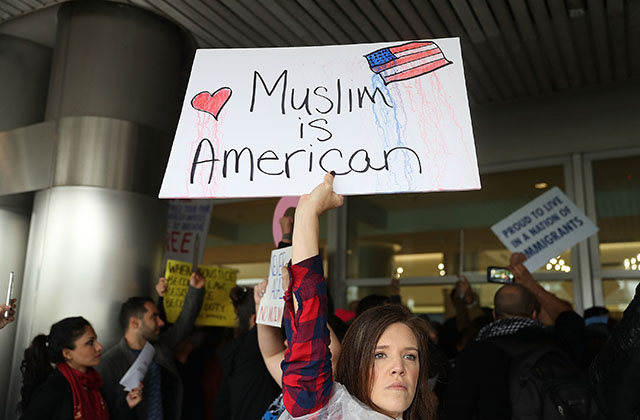
Demonstrators at Miami International Airport protest an executive order that President Donald Trump signed clamping downwards on refugee admissions and temporarily restricting travelers from seven predominantly Muslim countries on January 29, 2017. (Joe Raedle/Getty)
In the days subsequently the September xi terror attacks, President George Due west. Bush, disturbed by reports of hate crimes toward Muslims, turned to his secretary of transportation at a cabinet coming together. "We know what happened to Norm Mineta in the 1940s, and we're non going to let that happen over again," he reportedly said.
Mineta had been amidst the roughly 120,000 people sent to internment camps across the United States during World War 2 without due process for no reason other than their Japanese beginnings. Ten years old when he and his family were taken from their California home, Mineta spent years in a shoddily constructed Wyoming facility under armed guard. As a Chiffonier secretarial assistant six decades later, he said he drew on that experience when he decreed that there should be no racial profiling at airports.
Mineta's position echoed that of his boss. Six days later on the 9/11 attacks, President Bush sought to depict a clear distinction betwixt Muslims and the terrorists who had attacked America. While visiting a mosque in Washington, he said that "Islam is peace" and the targeting of Muslims "should not and that will non stand in America."
The current American president, nonetheless, has signaled a markedly different approach. Final calendar week, Donald Trump signed an executive lodge restricting entry to the United states of america by people from seven predominantly Muslim countries — an order ostensibly intended to protect against terrorism. During his campaign, Trump called for a "total and complete shutdown" of Muslims inbound the United states of america and floated the idea of registering Muslims in the country into a national database.
Among sizable public support for these policies, and as anti-Muslim hate crimes have returned to their highest levels since 2001, survivors and historians of Japanese internment are saying that lessons from that episode of American history seem to take been forgotten.
"Every bit a college instructor, I still find that my students' noesis is limited," Abbie Grubb, a lecturer of history at San Jacinto College in Houston who researches public remembering of Japanese internment, told Asia Society. "Usually about a third of them don't know anything about what happened. … By-and-big, it's still not something that's well-recognized."
In the aftermath of the Pearl Harbor attacks, President Franklin D. Roosevelt signed an executive society opening the door for military commanders to relocate people deemed security risks to "military areas." Japanese and Japanese Americans on the W Coast were then rounded upwardly and sent to internment camps around the country that ofttimes had overcrowded and poorly maintained living quarters.
The move had wide support among a nervous wartime public in the region, but it was also popular amongst whites who resented competition from Japanese laborers. "We're charged with wanting to get rid of the Japs for selfish reasons," the managing secretary of a farming association was quoted as saying at the fourth dimension. "Nosotros might likewise be honest. We exercise." Another fellow member of the group wrote to his congressman: "The Japanese cannot exist alloyed as the white race [and] we must do everything we can to stop them now as we have a gilded opportunity now and may never take it again."
A young Japanese American named Fred Korematsu refused to enter the camps in 1942 and was subsequently arrested. His legal claiming wound its way to the Supreme Court, which, despite the breathy absence of due procedure, ruled confronting him and upheld the legality of internment. The camps remained open up for the duration of the state of war and destroyed the lives of many of the detainees who had lost their property, jobs, and communities. It wasn't until the 1980s that the U.Southward. government formally admitted that internment had been a mistake.
All the same, in the backwash of the ix/eleven attacks, there were calls to use Japanese internment non as a cautionary tale, but as a precedent in support of profiling Muslims. A volume titled In Defense of Internment: The Case for Racial Profiling in World State of war II and the War on Terror garnered wide attending by arguing that internment had been justified. The author, conservative pundit Michelle Malkin, even chastised Norman Mineta for "milking his babyhood experience at a relocation military camp every bit an alibi to ban profiling at airports."
Actor George Takei shares a personal story from his childhood where stereotyping landed his family in internment camps. (six min., 8 sec.)
Fred Korematsu, 85-years-old by that time, published an essay in response to the book. "Fears and prejudices directed confronting minority communities are also like shooting fish in a barrel to evoke and exaggerate, oftentimes to serve the political agendas of those who promote those fears," he wrote. "I know what it is like to be at the other finish of such scapegoating and how difficult it is to clear one's name after unjustified suspicions are endorsed equally fact by the government."
But today, parallels betwixt the Japanese American experience in Globe War II and Muslim profiling are resurfacing. After Donald Trump's phone call to ban Muslim entry to the United States in late 2015, a reporter asked the and then-candidate if he would have supported Japanese internment. "I would have had to be in that location at the time to tell yous," he replied. The following twelvemonth, a spokesman for a Trump-supporting Super PAC cited Japanese internment every bit a precedent for creating a registry for Muslim immigrants.
Just equally after 9/11, prominent Japanese Americans have again stepped upwards to use the internment experience as a cautionary tale confronting policies targeting Muslims. Writing in the Washington Post in November, 79-twelvemonth-onetime actor and internment survivor George Takei said, "Information technology begins with profiling and with registries … In [Trump's] world, national security justifies actions that are 'sometimes not right,' and no 1 really tin guarantee where information technology volition end."
Days afterward, Norman Mineta one time again invoked his wartime feel. "In the decades that have passed, Americans said that it would never happen again," he wrote. "We would never let hatred and fright blind u.s. to our shared humanity. Nosotros prided ourselves on having evolved beyond such impulses that would brand us discriminate confronting an entire population based on where they came from, how they looked, or how they prayed. To our great sadness, we are seeing these spooky ideas creeping back into normal discourse around the world."
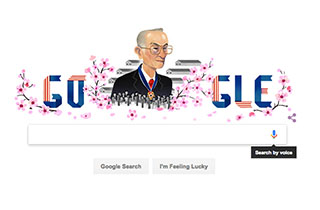
Congressman Mark Takano, whose parents and grandparents were sent to the camps, responded on Monday to President Trump's executive lodge by telling his fellow lawmakers: "If you are silent today, y'all would have been silent and then." Even Google appeared to draw the connection on Tuesday when it featured Fred Korematsu on its homepage.
Will these reminders exist heeded? Abbie Grubb said that while instruction virtually Japanese internment has improved significantly in the U.s.a. in recent years, information technology's however far from sufficient. "In textbooks, it ofttimes gets one of those sidebar-style mentions," she said. "Simply it'south still seen as a tiny bleep in comparison to the bigger spectrum of U.S. history. I think some people see it as only of import if you're Asian American, but it's much more important in the broader story."
She said that when she teaches her students near Japanese internment, they're most often curious about how it was able to happen. "1 of the things that I emphasize is the fact that this was unconstitutional, and when things like this happen, it's incumbent not simply on all 3 branches of regime to recognize that, but for people to oppose it," she said. "There was opposition to internment during the state of war years, simply it was pretty minimal."
"When you hear [Japanese interment] beingness discussed at such high levels every bit a precedent, I think information technology should serve every bit a warning," she added. "Information technology is a call for education and awareness to make sure people practise know what happened. … This is not a precedent for the United States to follow."
Source: https://asiasociety.org/blog/asia/japanese-internment-survivors-warn-against-repeating-historys-mistakes
0 Response to "Can the Oppsoe Internment Again Iraqi Internment Again"
Post a Comment